Rules
Part of Why does an analytics certification actually matter before you pay?
How to check an analytics certification before committing budget
Analytics certifications checked before you pay: blueprint, assessment format, renewal terms, five-year cost, reimbursement conditions and a named use.
This is a purchasing checklist. It assumes you have already decided that a credential is worth pursuing and are now choosing between specific ones, or verifying a single candidate before paying.
Every item is something you can check in an hour, from published material, before any money moves. Items you cannot verify are themselves findings.
What to take away
- Most of what decides whether a credential is worth holding is published somewhere and almost nobody reads it.
- The renewal terms and the reimbursement conditions cause more regret than the exam ever does.
- If the issuing body publishes no exam blueprint, you cannot tell what you are buying, and neither can a hiring manager.
Before you look at any specific credential
1. Write down the single outcome you expect.
One sentence, naming a gate you need to pass, a screen you keep failing, or a body of material you will not study without a deadline. Vagueness here is the reliable predictor of an abandoned registration.
2. Set a time budget and check it against the published study estimate.
Then double the issuer's estimate, because it is written by people who want you to register. If the doubled figure does not fit your next three months, the answer is not now.
Checking the credential itself
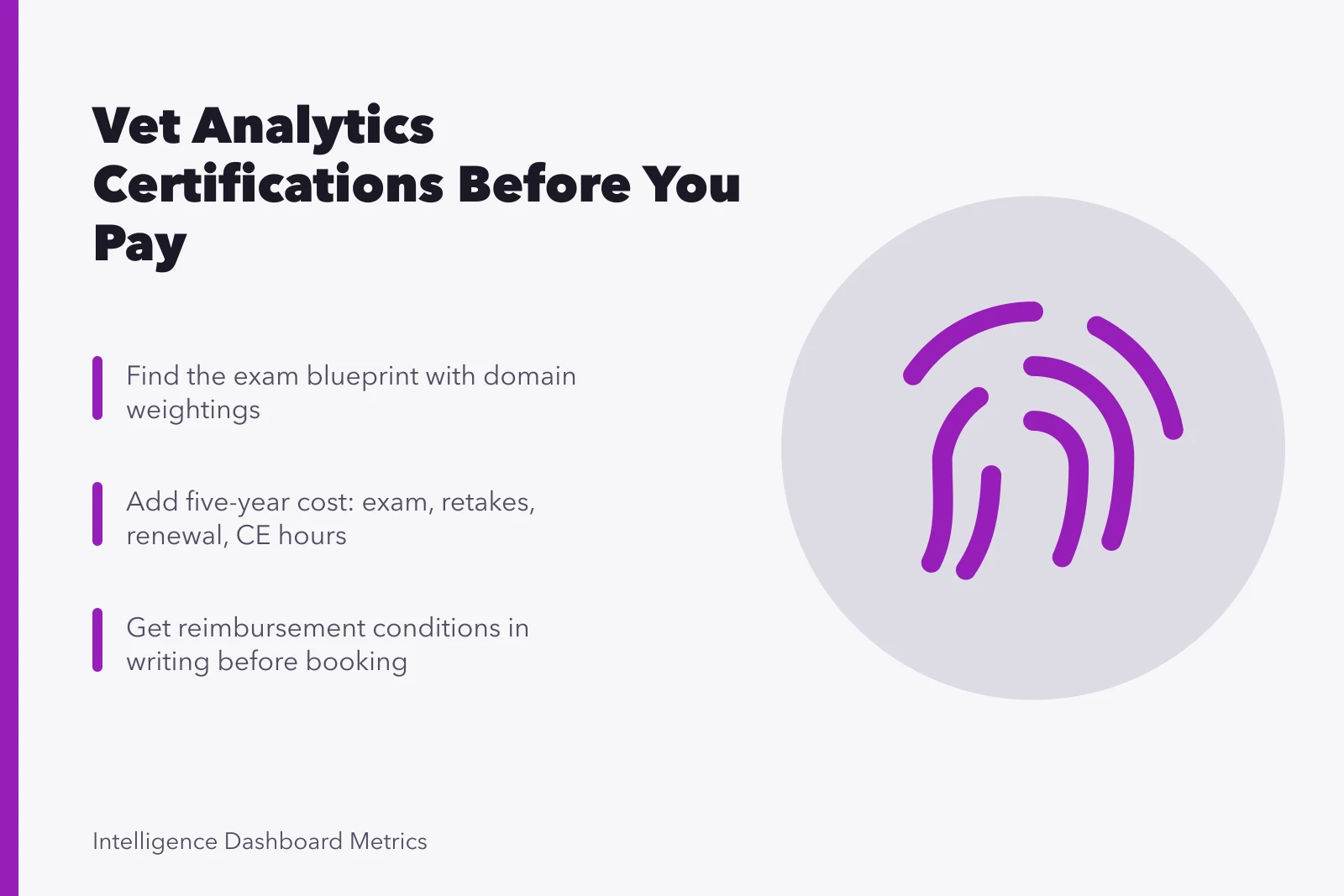
3. Find the exam blueprint or syllabus, with weightings.
Credential checks before paying
- Exam blueprint with domain weightings
- Independent proctored assessment, not attendance
- Sample items test reasoning, not interface recall
- Accreditation claim verifiable at accreditor's site
- Product-version tie-in and its dating schedule
A serious professional certification publishes what proportion of the assessment covers each domain. Without it you cannot judge the fit to your work, and you cannot tell whether the material is current.
4. Confirm whether passing requires an independent assessment.
Completing a course and passing an examination are different products that use similar words. Only one of them is a credential in the sense a hiring process treats as a gate.
5. Read the sample items, not the marketing.
Ten sample questions tell you more about the depth than any description. Look for whether they test recall of interface details or reasoning about a problem.
6. Check the accreditation or standards claim, and who makes it.
Some issuing bodies are accredited by an independent standards organization. Many are not, which is not disqualifying. What matters is whether the claim on the page is verifiable from the accreditor's own site.
7. Find out whether the credential is tied to a product version.
If it is, it dates precisely, and it dates on somebody else's schedule. That may still be fine when your employer runs that product, and it is worth knowing before rather than after.
Checking the ongoing commitment
8. Read the renewal terms in full.
Five-year cost components
- Exam feeusually the smallest component
- Retake policycost of a second attempt
- Study materialspriced into the total
- Renewal feesrecurring over five years
- Continuing education hourspriced at your time
Renewal period, continuing education requirement, fee, and what happens if you lapse. A lapsed credential on a profile dates your knowledge more precisely than having none.
9. Add up the five-year cost, not the exam fee.
Exam, retake policy, study materials, renewal fees, and the continuing education hours priced at whatever your time is worth. The exam fee is usually the smallest component.
Checking the practical conditions
10. Read the reschedule, retake, and refund policy before booking.
Retake waiting periods and non-refundable windows are where people lose money. This takes four minutes and prevents the most common avoidable cost.
11. If your employer is paying, get the conditions in writing.
Specifically: whether there is a repayment obligation if you leave within a period, who owns the credential, and whether study time is work time. Verbal agreements about reimbursement do not survive a change of manager.
12. Name what you will build with it inside ninety days.
A credential with no application decays immediately, and the application is what turns it into something you can talk about. If you cannot name the project, you are buying a certificate rather than a capability.
A pass and fail summary
Reasonable
- Blueprint
- Published with weightings
- Assessment
- Independent, proctored, with a pass standard
- Currency
- Dated syllabus, stated review cycle
- Renewal
- Terms and costs published up front
- Recognition
- You have seen it named in real postings in your market
Walk away
- Blueprint
- Not published, or vague topic list only
- Assessment
- Attendance or completion only
- Currency
- No date anywhere on the material
- Renewal
- Terms only visible after purchase
- Recognition
- Only the issuer says it is recognized
What this checklist does not decide
It does not tell you whether to get a credential at all, which depends on your market, your stage, and what you can show instead. It also cannot tell you whether a specific employer will value it, because that varies more between two companies in the same city than between two credentials.
For both of those, ask people doing the job you want, in the market you are in, and weight what they say about their own hiring process over anything published.
Related reading on this site
The decision to pursue one at all is in analytics certifications.
For the career context the decision sits in, see analytics careers and four axes and a planning pass.
The errors that make a credential a poor investment are in nine career mistakes. The shifts in how credentials are used as screening filters are in five shifts and how to test them.
Common questions
The issuer publishes no blueprint. Is that fatal?
It is close. Without a blueprint you cannot judge the content, cannot study efficiently, and cannot describe what you were assessed on. Prefer one that publishes it, even if it is otherwise less well known.
Should I take the cheaper of two similar credentials?
Compare five-year costs rather than exam fees, and then compare recognition in your own market. Price differences at the exam stage are usually the smallest factor in the comparison.
My employer will only reimburse after I pass. Is that normal?
It is common. What matters more is whether there is a repayment clause tied to leaving, and how long it runs. Ask for that in writing before you register.
What if the credential I want is brand new?
Then nobody recognizes it yet and you are buying the study rather than the signal. That can be a fine trade if the syllabus matches a real gap, provided you go in knowing which of the two you are getting.