Guides
Part of Five kinds of analytics careers, and what actually separates them
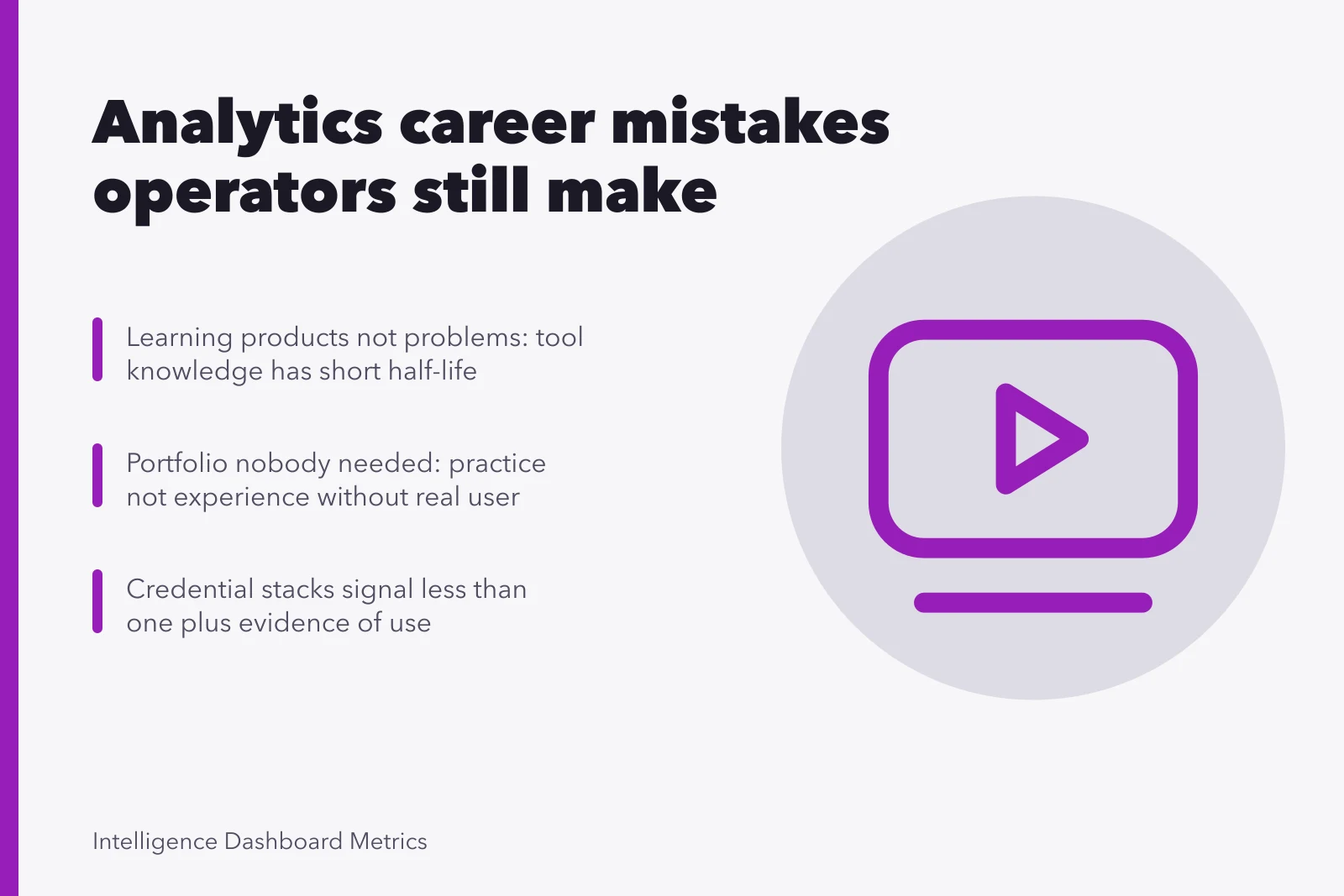
Analytics careers mistakes that experienced operators still make
Analytics careers damaged by legible choices: learning products not problems, portfolios nobody needs, credential stacks, and titles chosen over the work.
The mistakes below are not about skill. They are about where attention goes, and each one is a reasonable decision that pays off in the first year and costs in the fifth.
None of this is advice about what to want from a career. It is about the moves that reliably close options that people did not know they were closing.
What to take away
- The most expensive errors are made by capable people optimizing for something visible and short term.
- Anything learned as a sequence of steps inside one product has a shelf life nobody announces.
- Work that nobody uses is not experience. It is practice, and the two are not interchangeable on a resume or in your own ability.
1. Learning products instead of problems
Tooling knowledge is easy to demonstrate and easy to acquire, so it is where effort naturally goes. The half-life is short, and the depth is bounded: there is only so much to know about any one product.
Learn the problem it solves, in general terms, and let the specific product be an implementation detail. People who understand modeling, measurement, and process transfer between products in weeks. People who know one product transfer in years.
The card above was, for decades, the interface to data work, and expertise in it was a genuine and marketable skill. The skill went; the underlying questions about records, fields, and validation did not.
2. Building a portfolio nobody needed
Analyses of well-known public datasets are practice. They demonstrate that you can operate the tools, which is the least differentiated thing about you.
Practice notebook vs. real user tool
Public dataset notebook
- Who opens it
- Nobody
- What it proves
- Tool operation
- Hard parts appear
- No
- Differentiation
- Lowest
One-page tool in use
- Who opens it
- Local org, Mondays
- What it proves
- Problem understanding
- Hard parts appear
- Yes, with a user
- Differentiation
- Higher
Build something a real person uses, even a small one, even unpaid. A one-page thing that a local organization actually opens on Mondays is worth more than a notebook with beautiful charts, because the hard parts of the job appear only when there is a user.
3. Chasing the technique everyone is talking about
The methods that get discussed are not the methods that get used, and the gap is large. Effort follows the conversation because the conversation is what you can hear, which is the availability heuristic shaping a study plan.
Discussed methods vs. methods actually used
What gets talked about
- Source of signal
- The conversation
- Bias at work
- Availability heuristic
- Study plan effect
- Effort follows talk
What target roles use
- Source of signal
- Fifty job postings
- Bias at work
- Stated requirements
- Study plan effect
- Effort follows roles
Weight your learning toward what your target roles actually spend time on, which you can find out by reading fifty postings carefully instead of one article.
4. Collecting credentials as a substitute for a plan
Each one is a defined, completable thing in a career full of ambiguity, which is exactly why they attract people who feel stuck. The signal from a stack of them is weaker than from one plus evidence of use.
Credential accumulation is a well-described phenomenon in its own right, and degree and credential inflation describes the escalation it produces: as more people hold the marker, the marker distinguishes less.
Take one where a specific gap has been identified, then go and use it on something.
5. Staying because of what you already put in
Two years into a role that has stopped teaching you anything, the argument for staying is usually about the investment already made. That is the sunk cost fallacy in its most persuasive setting, because the investment was real and personal.
The only question is whether the next year in this role beats the next year elsewhere. What you already spent belongs to neither side of that comparison.
6. Taking the only-analyst role without asking about the sponsor
The mandate looks enormous and the learning is real. The failure mode is a role with no senior person invested in the outcome, where every request is a favor and nothing gets prioritized.
Ask who asked for the role to exist and what happens if you disagree with a department head. The answer to the second question tells you whether the job is possible.
7. Treating stakeholder work as beneath the technical job
The meetings, the ambiguity, and the explanation are widely regarded as overhead. They are the job in most analytics roles, and the people who are good at them become indispensable while the technically stronger colleague stays replaceable.
Get deliberately better at turning a vague request into an answerable question. It is a learnable skill and almost nobody practices it on purpose.
8. Never writing anything down
Analysis that lives in a notebook and a conversation disappears. The person who writes a short, clear summary of a finding gets associated with it; the person who did the work and said it out loud does not.
Write one page per piece of work, in plain language, and send it. This is the single highest return habit on this page.
9. Optimizing for title
Titles in analytics vary so much between employers that they carry little information. Choosing a role for its title routinely means choosing worse work with a better label, and the label does not transfer.
Choose for the mix of work, the review you will get, and the person you will report to. Those three determine what you can do in three years; the title determines a line on a profile.
The thread running through these
Most of them substitute something legible for something valuable. A credential is legible; judgment is not. A title is legible; the quality of your reviewer is not. Tool knowledge is legible; understanding a problem is not.
Legible things are easier to pursue because you can tell whether you have them. That is exactly why they are crowded, and why the returns are lower than they look.
Related reading on this site
The five kinds of work these mistakes happen inside are described in analytics careers, and the tooling questions behind the first mistake are in buying analytics tooling. For the credential decision specifically, see analytics certifications. The technical grounding worth having is in analytics foundations, and the function most of these roles sit inside is described in business intelligence.
Common questions
I already have four certificates and no job. What now?
Stop taking them and build one thing that a real person uses, then write it up in one page. The certificates are not wasted; they are simply not the missing piece.
How do I get stakeholder experience if my role has no stakeholders?
Volunteer for the request queue nobody wants, or find an internal team with an unanswered question. The unglamorous requests are where the skill is built, which is why they are available.
Is the only-analyst role always a bad idea?
No, and it is often the fastest learning available. The condition is a sponsor who wants it to work and a way of getting your judgment checked by someone outside the company.
What if my employer will only pay for a product certification?
Take it, and separately learn the general problem it sits inside. The paid credential is free money; the transferable understanding is the part you have to add yourself.