Rules
Part of Five kinds of analytics careers, and what actually separates them
Reading analytics careers metrics without fooling yourself
Analytics careers measured on yourself: unsupervised range, decisions changed, what survived, what you retired, and the parts that resist counting entirely.
Most people measure their own progress by things that are easy to count: tickets closed, tools learned, years accumulated. All three rise steadily while ability does not.
This page proposes measures you can apply to yourself once or twice a year. None of them involves money, because pay varies by market and employer far more than by capability, and a number here would tell you nothing about yourself.
What to take away
- Measure what you can now do unsupervised, and what happened to the work after you sent it. Those two cover most of it.
- Output counts are the wrong measure in both directionsthey reward small work and punish the work that removes whole categories of request.
- Some of the most important things here cannot be counted at all, and pretending otherwise is worse than describing them in words.
Measures worth checking on yourself
| Measure | How to take it | What a bad reading suggests |
|---|---|---|
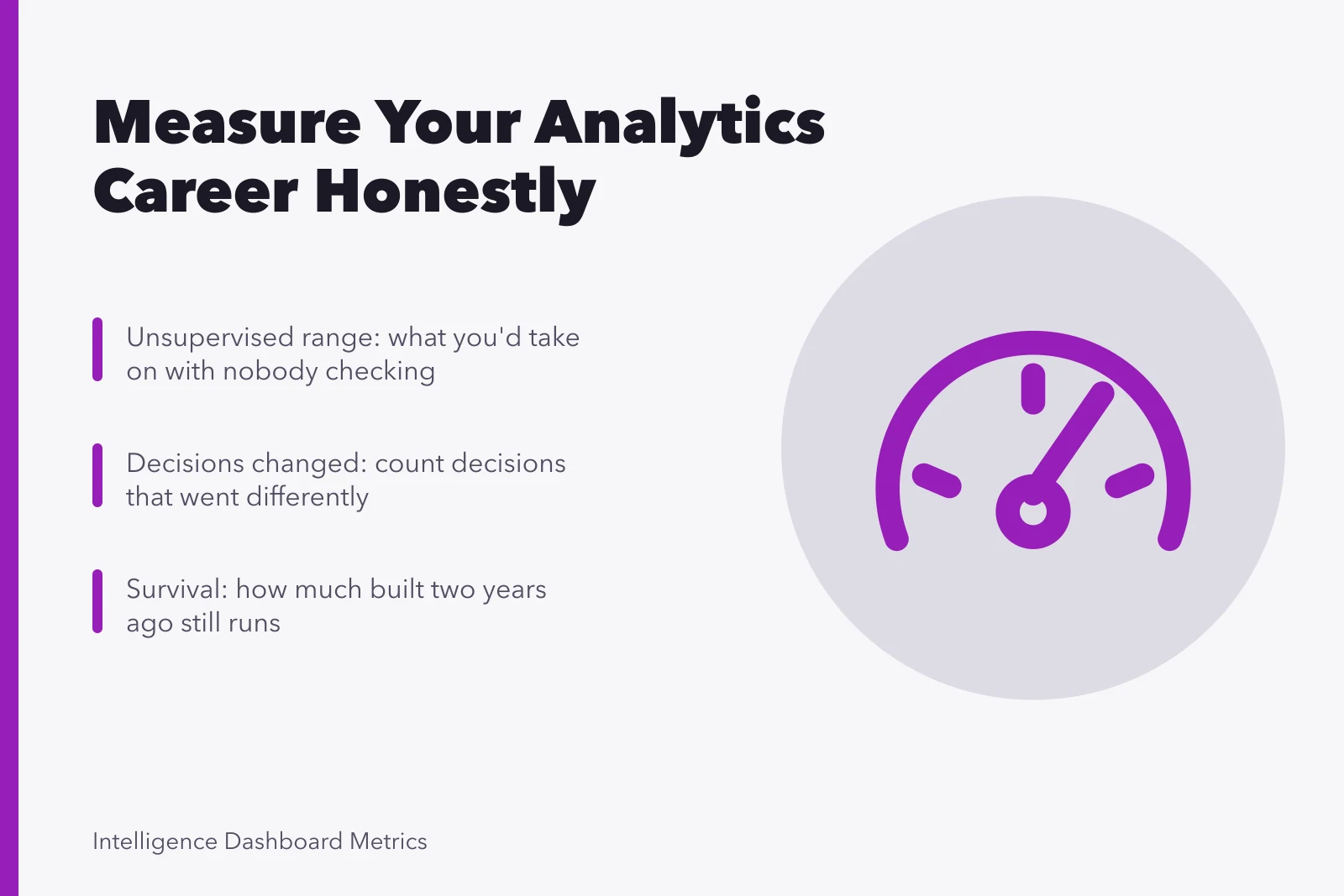
| Unsupervised range | List what you would now take on with nobody checking it | The range has not widened in two years |
| Decisions changed | Count the decisions that went differently because of your work | Your work is being read and not used |
| Survival | How much of what you built two years ago is still running | You build things that do not last, or nothing lasts here |
| Reach | How many distinct people bring you problems, and from how many functions | A narrowing reach means a narrowing role |
| Retirement | How many things you removed this year | Only ever adding is a warning sign |
| Question quality | Are you being asked better questions than you were? | Nobody has learned anything from working with you |
| Review received | How often somebody competent checks your work | Unreviewed work stops improving quickly |
The last row deserves particular attention early in a career. Two years without review is two years of habits setting, and it is the most common quiet failure in a small team.
Self-measures and bad readings
- Unsupervised rangeno widening in two years
- Decisions changedwork read, not used
- Survivalwhat you built does not last
- Reachnarrowing reach means narrowing role
- Retirementonly ever adding is a warning
- Question qualitynobody learned from you
- Review receivedunreviewed work stops improving
Why ticket counts are the wrong measure
An output count rewards small, well-defined work and penalizes the work that stops requests arriving. Somebody who removes an entire category of question by settling a definition and publishing it once looks unproductive by every count available.
This is Goodhart's law applied to yourself, which is the least defended position it can occupy. Where an employer measures throughput, you will drift toward it without deciding to, because the feedback is immediate.
The counterweight is to keep your own record of what stopped: requests that no longer arrive, spreadsheets retired, meetings that now begin from a shared screen. Nobody else will count those, and they are the strongest material in any performance conversation.
The things that will not be counted
Some of what matters here resists measurement completely. Whether people trust a number because you produced it. Whether your caveats are read. Whether a stakeholder now asks a sharper question than they did a year ago.
Treating only the countable part as real is the McNamara fallacy, and it is a particularly easy trap for people who work with data all day. The honest approach is to write these down in sentences, review the sentences annually, and accept that they are judgments rather than measurements.
A once-a-year exercise
Take an hour and answer six questions in writing.
Once-a-year written review
- What can I do unsupervised now?
- Which decisions changed? Name three
- What survived, what quietly died?
- Who brings me problems now?
- What did I remove?
- What did a competent person tell me?
Question six is the diagnostic. If the answer is nothing, either you are not being reviewed or you are not listening, and both are fixable this quarter.
Using this in a performance conversation
The measures above are more persuasive than a list of deliverables, and they are unusual enough that they change the tone of the discussion. Lead with decisions changed and with what you removed, because both are unambiguously about the business rather than about your activity.
Keep the evidence as you go. Reconstructing a year of decisions changed in the week before a review produces a vague list, and the specific ones are what carry.
Related reading on this site
The kinds of work these measures cover are in analytics careers, and the function most of them sit inside is in business intelligence.
For habits that make a bad reading likely, see nine career mistakes. For paths these measures play out along, see five career composites. The general problem of designing a measure that resists gaming is in metric shapes and their traps.
Common questions
My employer measures me on tickets closed. Can I ignore that?
No, but you can add to it. Deliver against their count and keep your own record of what stopped arriving. In most reviews the second list is what gets remembered.
What if nothing I built is still running?
Ask whether that is you or the environment. In some places nothing survives a reorganization, which says more about the place than about your work. If it is you, look at whether you build for the person asking rather than for the process.
How do I get review if I am the only analyst?
Buy it or borrow it. A few days of an experienced contractor, a peer at another company, or a community where you can post an approach and get it challenged. Manufactured review is worse than embedded review and far better than none.
Is two years long enough to judge any of this?
For unsupervised range and reach, yes. For survival and retirement, no: those need three to five years before they say anything, and reading them earlier will mislead you.