Rules
Part of Why does an analytics certification actually matter before you pay?
Analytics certification trends: what is loosening, and what is not
Analytics certifications trends you can test: softening requirements against unchanged filters, renewal as a business model, and a method beating opinion.
Claims about where credentials are heading are usually made by people who sell them or by people who resent them. Neither group publishes a method.
This page describes four shifts you can observe, gives a way to test each against your own market, and states plainly which parts nobody can tell you from a page.
What to take away
- Every claim here can be checked in an evening by reading postings and asking two recruiters. Do that instead of believing anyone, including this page.
- The gap between what employers say about credentials and what their screening systems do is the most important thing to understand.
- No figures appear here. Any number would be unsourced or drawn from a survey of whoever chose to answer.
The method, first
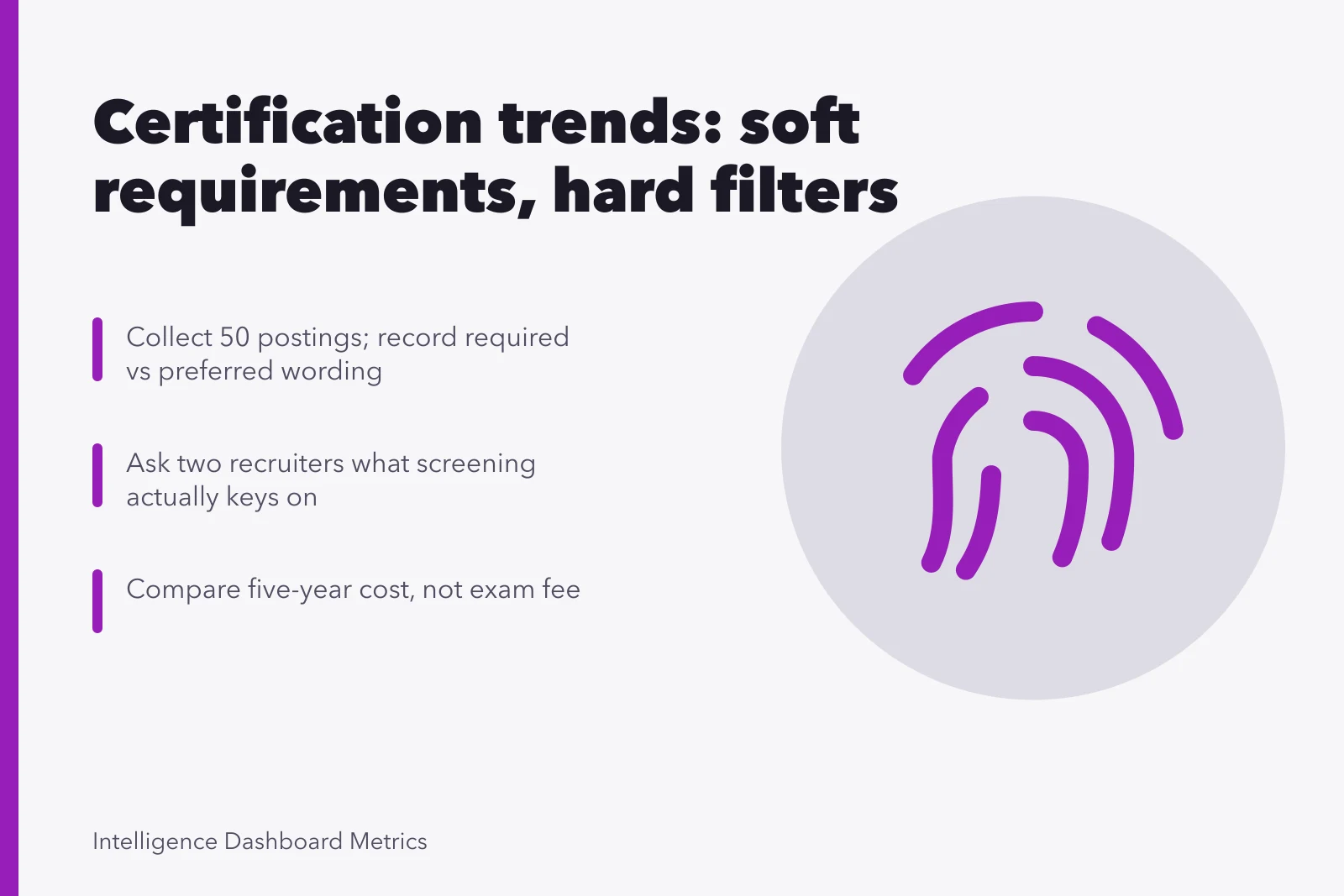
Collect fifty current postings for the roles you want, in your market, at the company sizes you would join. For each, record whether a credential is mentioned at all, whether the wording is required or preferred, whether a degree is named as an alternative, and whether a portfolio or work sample is requested.
Fifty-posting audit fields
- Credential mentioned at all
- Wordingrequired or preferred
- Degree named as alternative
- Portfolio or work sample requested
- Recruiter screening criteria
Then ask two recruiters who place in that market what their screening actually keys on. Recruiters answer this question straightforwardly and have no stake in your decision.
That exercise settles all four shifts below for your situation. Anything a general article tells you is drawn from whichever segment generates the most discussion, and inference from that segment to yours is selection bias with a confident tone.
Shift one: stated requirements are softening while filters are not
More postings describe credentials as preferred rather than required, and more explicitly accept equivalent experience. At the same time, automated screening continues to key on exact terms, because that is what automated screening does.
Stated requirements vs automated filters
Stated requirements
- Wording
- Preferred over required
- Experience
- Equivalent accepted
- Effect
- Credential optional
Automated filters
- Wording
- Exact terms only
- Experience
- Not parsed
- Effect
- Credential needed to reach human
Both are true, and the practical consequence is that a credential can be genuinely unnecessary for the job and still necessary to reach a human. Test it: count the required and preferred split in your fifty, then ask the recruiters what the filter looks for.
Shift two: work samples are being asked for alongside credentials, not instead
The predicted replacement of credentials by portfolios has not happened cleanly. What has spread is asking for both, with the credential clearing the screen and the work sample deciding the conversation.
Test it: count how many of the fifty ask for a portfolio, a take-home exercise, or a link to something you built.
Shift three: renewal is becoming the business model
Credentials increasingly carry continuing education requirements and recurring fees. From the issuer's side this is defensible, since it keeps holders current in a field that moves. From the holder's side it converts a one-time purchase into a subscription.
Test it: compare the five-year cost of the credentials you are considering, not the exam fee. The differences at five years are frequently the reverse of the differences at registration.
Shift four: the marker distinguishes less as more people hold it
This is not a prediction, it is a mechanism. A marker carries information because it is costly to obtain and easy to verify; as the number of holders rises, the information it carries about any individual falls, and the pressure moves to the next marker. That escalation is exactly what credential and degree inflation describes.
Test it: ask people who have been in your market for a decade what a given credential meant when they entered and what it means now. The answers are usually consistent and slightly depressing.
What nobody can tell you from a page
Whether a specific credential is worth it for you, in your market, at your stage. That depends on the roles you are targeting, the company sizes, the country, the sector, and what else you can show, and it varies more between two employers in the same city than between two credentials.
Anyone who answers that question without asking about your market is answering a different question.
Why articles about this are so confident
Trend writing is drawn from what is being talked about, and what is being talked about is not a random sample of what is happening. The vividness of a recent discussion is a poor guide to its frequency, which is the availability heuristic shaping a whole genre.
The correction is not skepticism as an attitude. It is the fifty postings, which takes an evening and replaces the entire genre for your own purposes.
Related reading on this site
The decision framework is in analytics certifications, and the market-checking habit is developed further in five shifts and how to test them. For the verification sequence before paying, see twelve checks before you pay, for the errors that follow a poorly framed decision see nine credential mistakes, and for the wider career context see analytics careers.
Common questions
Fifty postings, again?
It is the same evening's work and it answers both career and credential questions at once. Do it once a year and you will be better informed than almost anyone advising you.
Are recruiters really willing to say what the filter looks for?
Most are, if you ask narrowly. The question that works is what terms a search is run on for this kind of role, not whether credentials matter.
If filters key on exact terms, should I just list the term?
List only what you hold. Claiming a credential you do not have is trivially verifiable and ends a process badly. What you can legitimately do is describe the underlying skills in the words the market uses.
Will any of these shifts reverse?
Possibly, and you would find out through the same exercise. That is the argument for owning a cheap method rather than a set of conclusions with a shelf life.