Industry
Part of Five kinds of analytics careers, and what actually separates them
9 things worth knowing about analytics careers trends
Analytics careers trends tested rather than asserted: five observable shifts, plus a fifty-posting method for checking each one against your own market.
Trend pieces about analytics careers are usually assertions with no way to check them. This one contains no figures, because any number offered here would be unsourced, stale, or drawn from a survey of whoever answered.
Instead: five shifts that are visible in how teams are organized, with a method for testing each one against your own market rather than believing it.
What to take away
- You can test almost any claim about your field by reading fifty job postings carefully. Nobody does this, and it takes an evening.
- Trend claims are sampled from the loudest part of the market, which is not the largest part.
- The durable shifts are structuralwhere a layer of work sits, who owns it, and what a team is expected to stop doing.
First, the method
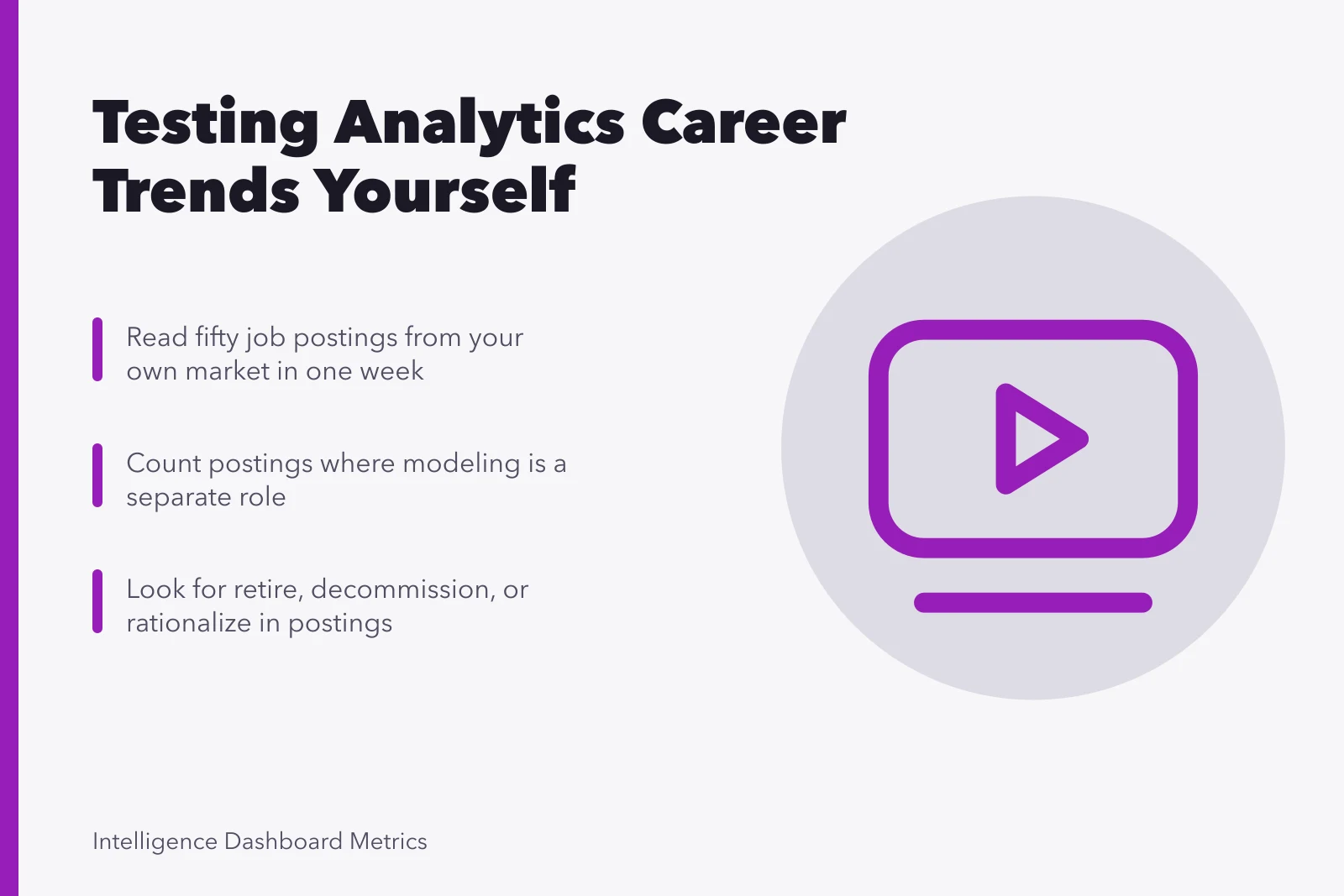
Take fifty postings from employers you would actually work for, in your own market, collected over one week.
Fifty-posting market check
- Collect 50 postings over one week
- Record titles used
- Note which of five work kinds
- Check modeling layer separate from reporting
- Note credential required or preferred
- Note communication asked for
That exercise answers most trend questions for your situation, which is the only situation that matters. It also inoculates you against the sampling problem: articles are written about the segment that generates conversation, and inference from that segment to the whole market is selection bias in its plainest form.
For a description of an occupation built on a consistent method rather than on commentary, an occupational reference is the right complement. The entry for data scientists in the Occupational Outlook Handbook sets out duties, entry paths and outlook using the same framework applied across every occupation, which is what makes it comparable.
Shift one: the modeling layer has become its own job
The work of turning raw source tables into clean, tested, documented models used to be split between whoever loaded the data and whoever queried it. In many organizations it is now a distinct role with its own review standards, closer to software engineering than to analysis.
This is essentially ordinary extract, transform, and load work given a review discipline and a home. How to test it: count how many of your fifty postings describe the modeling layer separately from reporting responsibilities.
Shift two: reporting is expected to shrink
More teams now describe part of their mandate as retiring things: reducing the estate, replacing recurring requests with a settled definition, cutting dashboards. This is a real change from an era where delivery volume was the measure.
How to test it: look for the word retire, decommission, or rationalize in the postings, and ask about it directly in interviews.
Shift three: self-service keeps being promised and keeps arriving partially
The expectation that business users answer their own questions is durable and its delivery is not. What usually arrives is self-service within a curated layer for well-defined questions, with everything else still coming to the team.
The career consequence: work moves upstream. Less answering, more building the layer that answers.
How to test it: ask what share of questions the team no longer receives, then compare that with what the tooling was meant to achieve.
Shift four: the routine parts of the technical work are getting cheaper
Writing a query, producing a first chart, drafting boilerplate transformation code: all of these are faster than they were, whatever tooling a given team uses. What has not become cheaper is knowing which question to ask, whether the data can answer it, and what the answer means for a decision.
The practical implication is a widening gap between people whose value is production and people whose value is judgment. How to test it: look at what the senior postings emphasize compared with the junior ones, in the same organizations.
Shift five: credentials are being asked for less as requirements and more as filters
Postings increasingly list credentials as preferred rather than required, while automated screening continues to use them as a filter. Both things are true at once and they pull in opposite directions.
Required vs preferred credentials
Posting language
- Stated requirement
- Preferred, not required
- Direction
- Loosening
- Your check
- Count the split
Screening reality
- Stated requirement
- Still a filter
- Direction
- Tightening
- Your check
- Ask a recruiter
How to test it: count the split between required and preferred in your fifty, and separately ask a recruiter in your market what their screening actually keys on.
What has not changed
Two things matter more than any of the shifts above. The bottleneck in analytical work is still turning an unclear request into an answerable question, and it is still the least practiced skill in the field.
And the value of a piece of analysis is still decided by whether somebody acted on it, which no change in tooling has affected in either direction.
How to use a trend claim, including these
Treat any claim about the field, from anywhere, as a hypothesis about your market until you have checked it. The check is cheap. The cost of acting on a trend that is real in one segment and absent in yours is a year of misdirected effort.
Related reading on this site
The five kinds of work behind the titles are in analytics careers. The axes on which these shifts might matter to you are in four axes and a planning pass.
For errors trend chasing produces, see nine career mistakes. The credential question from shift five is in analytics certifications, and the function these roles sit inside is in business intelligence.
Common questions
Fifty postings is a lot. Is twenty enough?
Twenty will show you the obvious patterns and will mislead you on anything close. If you only have time for twenty, treat the result as a hint rather than as a finding.
Should I chase the modeling layer because it is growing?
Only if the work suits you. A growing category is easier to enter and no more pleasant to be in, and the field has plenty of people who moved toward growth and away from what they were good at.
How often should I redo the posting exercise?
Once a year, and again whenever you are considering a move. It takes an evening and it replaces a great deal of secondhand opinion.
Do any of these shifts make a specific skill obsolete?
Not on this list. What changes is the price of a skill relative to others, which is a different thing from obsolescence and calls for rebalancing rather than abandonment.