Reviews
Part of Five kinds of analytics careers, and what actually separates them
What connects several very different analytics careers paths?
Analytics careers shown as five invented composites, each followed by the part that genuinely generalizes and the structural opening that made it possible.
Career advice in analytics is mostly anecdote wearing a pattern's clothes. Somebody describes the route they took and it gets repeated as though it were a route anyone could take.
The five composites below are invented. Each one is assembled from the shape of a common path rather than from a person, and each is followed by the part that actually generalizes, which is usually smaller than the story.
What to take away
- The transferable part of any career story is the mechanism, not the sequence. Ask what made the move possible, not what order things happened in.
- Every path here was enabled by something structurala gap in the organization, a departure, a system migration. Skill was necessary and not sufficient.
- Stories you hear are drawn from the people it worked for, which is why the advice inside them is systematically overconfident.
Composite one: the operations analyst who became the modeler
Started in a scheduling team, built spreadsheets nobody asked for, and got noticed when a manager wanted the same figures weekly. Moved into the data team when it was created, and spent two years being the only person who understood the operational meaning of the source tables.
Domain knowledge vs technical skill
Domain knowledge
- Acquired
- Before technical skill
- Hiring difficulty
- Hard to hire
- Durability
- Durable advantage
- Source
- Operations tables
Technical skill
- Acquired
- On the job
- Hiring difficulty
- Easier to hire
- Durability
- Replaceable
- Source
- Tooling and models
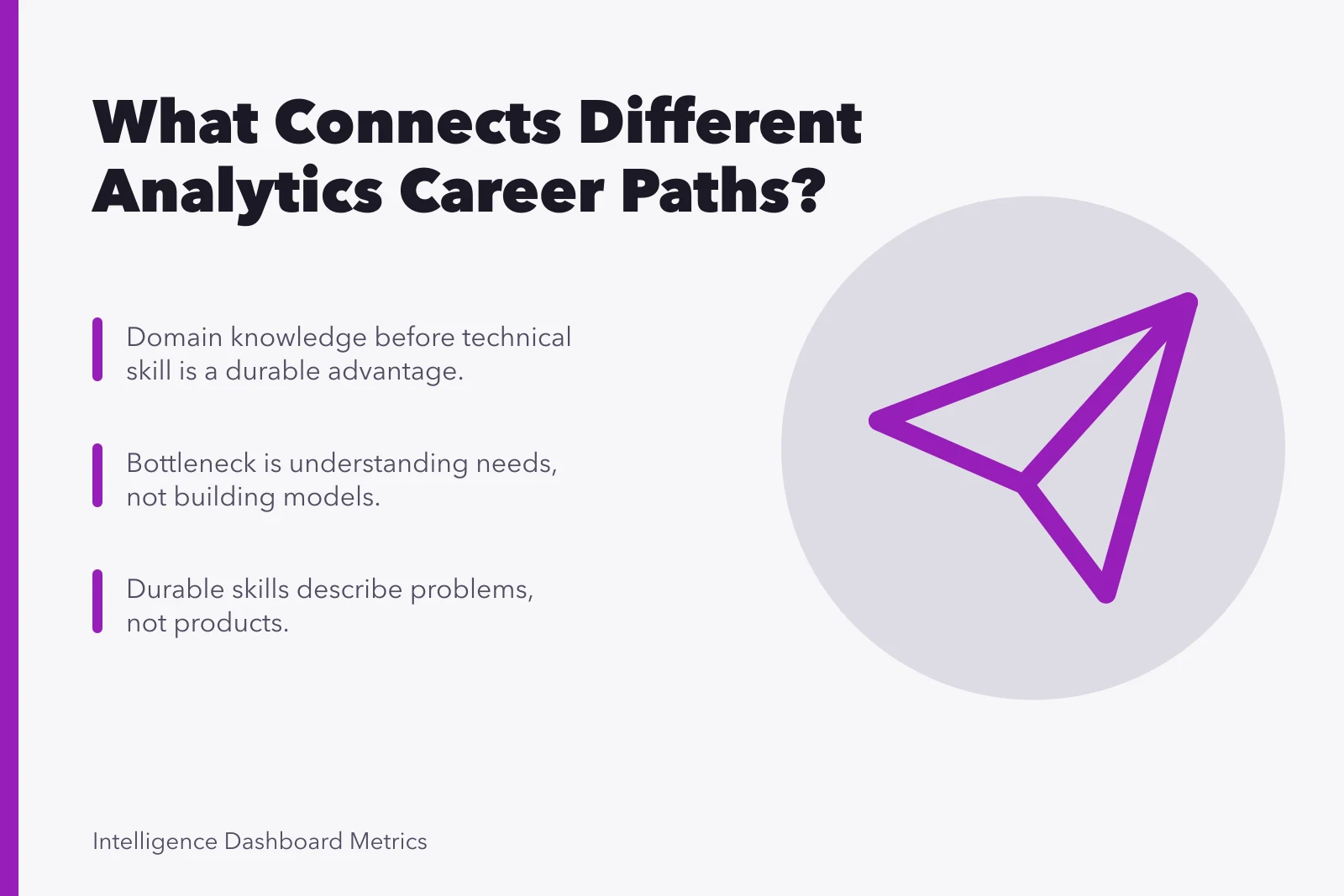
What generalizes: domain knowledge acquired before technical skill is a durable advantage, because it is the half that is hard to hire. The move worked because the organization was building a data team, which was not something the person controlled.
Composite two: the engineer who moved sideways and stalled
Came from software, learned the tooling quickly, and produced technically excellent models that nobody used. Struggled for a year, then improved sharply after being made to sit in the operations meeting every week.
Engineer's sideways move and stall
- StartCame from software, learned tooling quickly
- EarlyProduced excellent models nobody used
- StruggleStruggled for a year
- Turning pointMade to sit in operations meeting weekly
- AfterImproved sharply
What generalizes: the bottleneck in most analytics roles is understanding what someone needs, not building it. Technical strength can delay the discovery of that by about a year, because early work looks productive.
Composite three: the only analyst
Joined a small company as its first analytical hire with a mandate covering infrastructure, modeling, reporting, and stakeholder work. Delivered a great deal, learned enormously, and left after two years with a broad but shallow profile and no reviewer who had ever checked their work.
What generalizes: breadth is real and the missing piece is feedback. Somebody in this position should manufacture review deliberately, through a community, a mentor, or a contractor engaged for a few days.
Composite four: the specialist whose specialty was absorbed
Spent four years deep in one technical area. The area became a feature of a platform, the work shrank, and the skill did not transfer as cleanly as expected because much of it was product-specific rather than conceptual.
What generalizes: durable skills are the ones that describe a problem rather than a product. Anything learned as a set of steps inside one system carries a shelf life, and the shelf life is not announced.
Composite five: the manager who stopped building
Became a lead, kept a hand in for a year, and then stopped. Two years later could no longer evaluate the technical quality of the team's work and had to rely on their judgment entirely.
What generalizes: this is a real trade and not a failure. What makes it survivable is keeping one recurring technical task, small and genuine, so that the ability to read work does not decay with the ability to produce it. Keeping one small technical task is also how a manager avoids the analytics foundations mistakes that stall new teams.
What all five have in common
Each move was made possible by a structural opening. A team being formed, a person leaving, a system being replaced, a mandate expanding. None of the five could have created the opening, and all of them were positioned when it appeared.
The practical consequence is unglamorous: the controllable part of a career is the positioning, which means visible work, a reputation for a specific kind of problem, and relationships outside your own team. The opening arrives on its own schedule.
How to read stories like these, including these
Stories circulate because they ended well. The ones that ended badly are not told, so the population you learn from is filtered before you see it. That is survivorship bias operating on career advice, and it makes every path sound more reliable than it was.
For a description of the work that is not filtered this way, an occupational reference is a better starting point. The published entry on data scientists in the Occupational Outlook Handbook describes duties, entry requirements and outlook using a consistent method across occupations, which is exactly what an anecdote cannot give you.
Related reading on this site
The five kinds of work behind analytics job titles are described in analytics careers. For the daily craft most of these paths share, see how to work through a question.
The technical foundations these roles rest on are in analytics foundations. The function most of them sit inside is described in business intelligence. For the credential question that arrives at every one of these transitions, see analytics certifications.
Common questions
Are these real people?
No. Each is a composite assembled to show a shape, with no individual behind it. Treat them as illustrations of a mechanism rather than as evidence of anything.
Which composite is the best path?
None of them. The first and third produce the fastest learning and the highest risk, the fifth is a trade rather than a step, and which is right depends on what you want your day to contain.
How do I create a structural opening rather than wait for one?
Mostly you cannot. What you can do is notice them earlier than other people, which comes from talking to people outside your own team about what is changing in theirs.
Is domain knowledge really worth more than technical skill?
Not universally. It is worth more in roles that serve a business function directly, and worth much less in roles that build shared infrastructure. Match the emphasis to the kind of work rather than to a general claim.